

By Jon Bergmann
In 2007, when Aaron Sams and I first started recording our chemistry lectures so our students could watch them at home, we didn’t realize we were starting a movement. We just wanted to stop “teaching to the middle” and start reaching the students who were struggling or ahead. We called it the Flipped Classroom. For nearly two decades, that model has been about one thing: maximizing the face-to-face time between a teacher and a student.
Today, in my 40th year of teaching, I find myself standing at the precipice of a second, even more profound revolution. If the original Flipped Classroom was about reclaiming the “Group Space,” then the next evolution—The Mastery Flip—is about protecting the human mind from the very tools designed to assist it.
The Great Bifurcation: Crutch vs. Engine
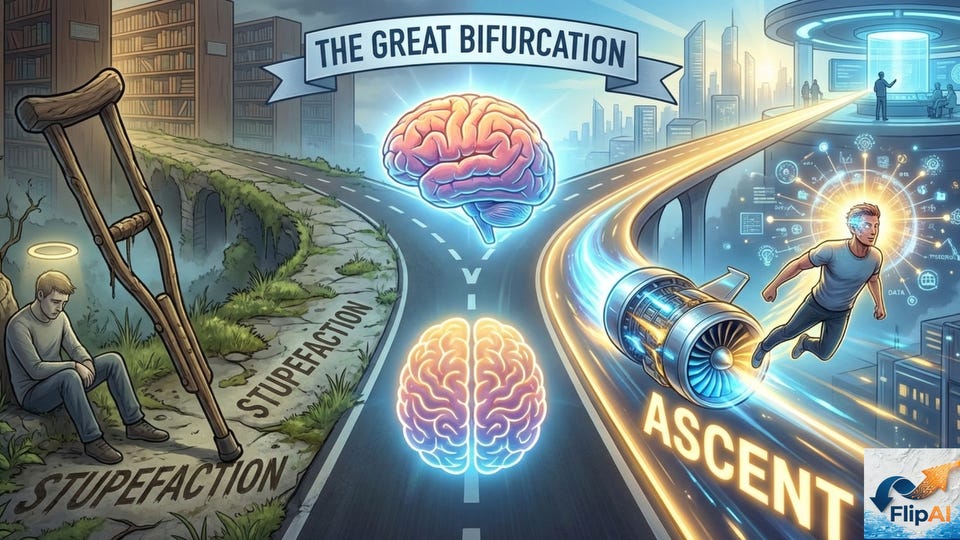
As I watch my students interact with AI today, I see a “Great Bifurcation” forming. It is a fork in the road that will define the next decade of education.
The Path of the Crutch (The Stupefaction Trap): This is the future where AI becomes the ultimate shortcut. When a student treats AI as a ‘Magic Button’ that gives them the answer rather than an engine for their ‘productive struggle,’ their brain atrophies. We risk raising a generation that is ‘stupefied’ by AI—dependent on an algorithm to tell them what to believe.”
The Path of the Engine (The Soaring Generation): This is the path of The Mastery Flip. An engine doesn’t replace the driver; it allows them to go further. In this future, students use AI as a Socratic tutor—a thinking partner that pushes them to synthesize and elaborate. These students won’t just keep up with the world; they will soar in it.
The New Rule of Homework
In the “old” flip, the Independent Space (homework) was static. Today, AI can solve that problem, but it has created a new one. The reality of the modern classroom is this: We can no longer send home cognitively complex materials. It is simply too tempting for students to push the magic button and let a chatbot do the heavy lifting for them. When the struggle goes home, the learning often vanishes into a prompt.
To avert this stupefaction, I am flipping the model again. We must use digital tools to clear the fog at home, but we must bring the “heavy weights” back into the classroom.
The Mastery Flip
The Mastery Flip is built on three pillars: AI Engines, Analog Roots, and Human Checks. But here is the truth: while the vision is clear, the infrastructure is not yet built. We are at the “dial-up” phase of educational AI. To reach the summit, we must build a new architecture for learning.
Pillar 1: AI Engines (Turbocharging the Independent Space)
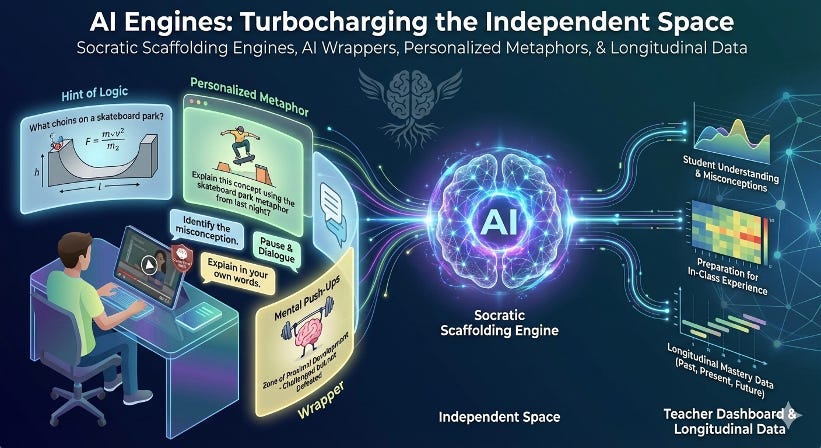
In the “old” flip, the Independent Space was static. If a student got stuck at the three-minute mark of a video, they stayed stuck until they saw me the next day.
In The Mastery Flip, that Independent Space becomes a vibrant, adaptive conversation. But this requires more than just a generic chatbot; it requires AI Wrappers specifically designed for cognitive development. I am calling for a new class of “Socratic Scaffolding Engines.” These wrappers are the primary interface of the Mastery Flip, ensuring the AI serves the student’s mind rather than replacing it. Imagine a student working through a lesson at home. When they hit a wall, a robust AI-wrapper—specifically programmed with my pedagogical “flavor”—engages them.
This wrapper doesn’t provide a solution; it provides a “hint of logic.” It identifies the specific misconception, offers a personalized metaphor (like comparing a complex concept to gaming or sports), and ensures the “mental push-ups” are still done by the student. These tools will provide the precision necessary to keep the student in the Zone of Proximal Development—challenged but never defeated. And of course, I’ll be fully briefed by the AI tool so I can be there and fulfill my role as teacher and human learning guide when I work with the student the next day. I’ll use the student’s confusion or problem to improve my lesson as well.
Pillar 2: Analog Roots (The Anchor of Learning)
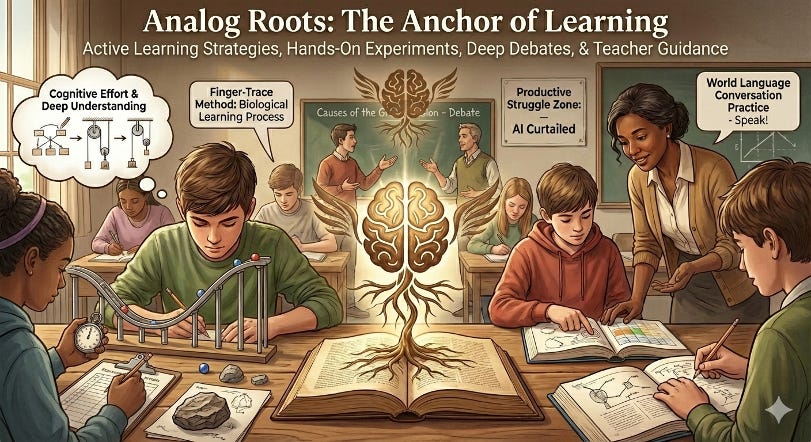
Thriving doesn’t only happen behind a screen. I am increasingly intrigued by the “Analog Roots” movement. There is a growing realization that “low-tech” often means “high-cognition.” The Analog Anchor levels the playing field, ensuring that the focus remains on the student’s internal logic rather than their access to high-speed home internet or premium AI models
In The Mastery Flip, analog work is the anchor. We must resist the urge to digitize everything. I see a future where AI serves as the “Pre-Check,” while “Deep Work” happens on paper. Whether a student uses an AI engine to clear the fog or a physical textbook to find the light, the goal remains the same: protecting the biological necessity of cognitive effort. Learning is a biological process; cognitive effort is what builds cognitive capacity.
To that end, I call for a resurgence of student use of printed materials. In my class, students answer questions in packets, and that leads to deeper understanding. I emphasize that this is best done in class, where AI use is curtailed, and students go through productive struggle. The idea of having the hard parts done in class has been central to the flipped learning movement since its inception. The beauty is that when students are struggling, they struggle in the presence of the most valuable resource in all of education: the expert teacher. The teacher can then monitor student understanding and quickly address any misconceptions.
Additionally, we need to ensure our classrooms use the best active learning strategies. As a science teacher, that means lots of hands-on experiments, such as students working with rocks or measuring a marble as it rolls through a roller coaster-like setup. For a history teacher, that might be a whole-group discussion and debate about the causes of the Great Depression. For a world language teacher, it would mean more time practicing speaking the target language.
Pillar 3: Human Checks (Validating the Cognitive Journey)
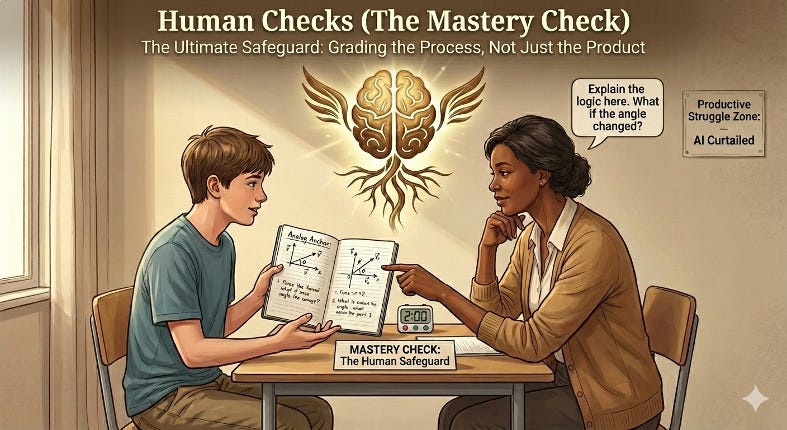
While the Analog Roots provide the soil for the struggle, the Human Checks are where we harvest the results, ensuring that the roots have taken hold in the student’s mind. This will prevent the “stupefaction” of AI misuse. We must move from grading the Product to assessing the Thought Process. This is where teachers validate student mastery. Ideally, letter grades will have gone by the wayside, and newer forms of useful assessment will be in place, revealing what the student knows and can do!
The Artifact (The Analog Anchor)
The paper packet mentioned in pillar 2 is no longer just a worksheet; it is the “Analog Anchor” that the student must physically bring to the table. It serves as the primary data source for the conversation, ensuring that no screen comes between the teacher and the student’s logic.
The Interaction (Mastery Check)
In my classroom, a Mastery Check is a two-minute, high-impact conversation. A student sits with me; they bring their Analog Anchor—the paper where they’ve sketched their force vectors or mapped their geological strata. Usually, I just want them to have only paper. However, I do see utility in having a student laptop to expand our conversation. For example, recently, when discussing how streams flow into the ocean, I pulled up Google Maps, and we zoomed into the mouth of the Amazon River to understand the nature of a river delta and its distributaries.
During the check, I ask students to explain what they learned. I get them to delve deep into the content. In the future, I see AI as a tutor that prepares them for a more involved mastery check that gets to the heart of the learning. This is a work in progress for me - and I am discovering that having the right questions is and will be key to making the most of these two minutes, which is why I’m looking for AI-driven Coach’s Assistants to help suggest these deep-dives in real-time. The good news is that you cannot fake a Mastery Check with an AI. If they used a crutch, it would become immediately apparent. If they used an engine, they soar.
The Result (Retrieval Mastery)
We are discovering that the true power of the Flipped Classroom isn’t just about ‘when’ the lecture happens; it’s about creating the space for Retrieval Mastery during the school day. While it is tempting to believe that students no longer need to “know” facts because they can look anything up, cognitive science suggests otherwise. Research by Roediger and Karpicke (2006) on the “Testing Effect” shows that retrieving information from memory—without external support—encodes learning for the long term.
Furthermore, John Sweller’s (2011) work on Cognitive Load Theory explains that critical thinking cannot happen in a vacuum. If a student hasn’t internalized foundational concepts, their working memory becomes overwhelmed by the basics, leaving no room for high-level synthesis. By requiring students to demonstrate knowledge without a digital crutch, we aren’t being “old school”—we are freeing their brains to do the complex work that AI cannot.
To that end, my students still take traditional exams. These exams are high-stakes, and students have to master the content. The twist in my class is that students must retake exams until they demonstrate mastery. All exams are done on school-issued laptops with a lockdown browser. The software I use to deliver the tests delivers different tests to each student, so if they need a retest, they get similar questions that assess the same objectives.
The Learning OS: A Foundation for Human-to-Human Mastery
To move beyond AI Stupefaction, we need more than a collection of apps. We need a Learning OS—a unified architecture that treats AI as an engine, not a replacement for thought. This OS provides the overarching structure that ensures every digital interaction leads back to a physical pen and a human conversation.
Within this system, six specialized wrappers act as the “drivers” that power the student journey:
I. The Infrastructure Layer (The Setup)
These wrappers define the system’s rules and memory before the student begins.
The Tuned Coach: The OS is not a generic bot. This wrapper ensures the AI is trained on my specific pedagogical voice, my unique metaphors, and my high standards. When a student interacts with the system, they are engaging with a digital extension of their teacher, ensuring consistency between the home and the classroom.
Longitudinal Mastery: We must end the “one-year reset.” This wrapper maintains a persistent, atomic map of everything a student has mastered—and every gap remaining—from kindergarten to graduation. It allows the Learning OS to treat education as a continuous journey rather than a series of isolated, forgotten units.
Engineered Productive Struggle: This is the logic gate of the system. It is hard-coded to withhold answers. This wrapper mandates that the AI only offers scaffolding after the student has demonstrated authentic effort. This specific wrapper’s job is to “disable the Magic Button”. By hard-coding the AI to withhold answers, you ensure it functions as a “Thinking Partner” rather than a “Button” that solves the problem for the student. It ensures that the “Magic Button” is replaced by a “Mental Gym.”
II. The Home Warm-Up (The Pre-Work)
These wrappers manage the student’s first contact with new concepts.
The Content Wrapper: This transforms the flipped video into an active Socratic dialogue. As a student watches at home, the AI pauses to ask questions, requiring the student to explain concepts in their own words. It identifies “cognitive fog” early, generating a conceptual heat map so I know exactly where the class is struggling before the bell rings.
The Translator Wrapper: If a student hits a wall because the vocabulary is too abstract, this wrapper instantly re-renders the core concept into their “native cognitive language.” Whether they think in the metaphors of a skateboarder or a musician, the AI bridges the gap to the rigor without ever lowering the standard.
III. The Group Space (The Analog Roots)
This wrapper supports the student during the “messy middle” of solving problems.
The Unstuck Wrapper: This is the vital bridge back to Analog Roots. When a student is stuck on a handwritten problem, they show their work to the AI. The wrapper analyzes their specific error and provides a “hint of logic” to get them moving again. It provides the scaffolding of an AI Engine while keeping the pen in the student’s hand.
The Result: The Human Check
The ultimate goal of the Learning OS is to clear the path for the Mastery Viva. Because the AI has handled the repetition, the scaffolding, and the data-tracking, the teacher is freed to do what only a human can: look a student in the eye, verify their understanding, and celebrate their growth.
In this new ecosystem, the AI is the engine and the Analog is the anchor—but the teacher remains the bridge to mastery.
A Call to Action: Scaling the Human Connection
For forty years, we’ve been haunted by Bloom’s 2-Sigma Problem: the fact that one-on-one tutoring results in two standard deviations of improvement, yet we lacked the manpower to scale it. The underlying magic is that personalized education that engages every student and meets their needs and satisfies their curiosity is the start of the golden age of education for all students.
The Mastery Flip is that scale.
But we cannot reach this future with the generic tools we have today. This is a call to the visionary educators, the developers, and the school leaders: let’s stop building “productivity tools” for AI and start building “cognitive engines” for students.
We must challenge our developers to move beyond the era of the ‘Magic Button.’ In the world of business, a tool that bypasses effort is a ‘productivity gain.’ But in the world of education, a tool that bypasses effort is a ‘cognitive loss.’ We don’t need more apps that act as shortcuts to a final answer; we need ‘Cognitive Engines’ that demand human effort, protect the productive struggle, and ensure that AI remains the fuel for the mind—never a ‘button’ that replaces the brain.
We must advocate for an educational ecosystem that:
Prioritizes the Socratic Dialogue: We need systems that value the “productive struggle” as much as the final solution.
Protects the Analog Anchor: We must ensure that technology serves as a bridge to deep, physical work, rather than a replacement for it.
Elevates the Human Check: We need to demand that “success” is measured by a teacher’s validation of a student’s thought process, not just a data point on a dashboard.
The Mastery Flip is that scale. It isn’t about replacing the teacher with a robot; it’s about using the robot to free the teacher to be more human. As I shift from “Information Provider” to Cognitive Coach, I see a horizon where every student has the support to become a high-flyer.
We have the tools and the research. Now, we just need the courage to demand the struggle, the wisdom to protect the roots, and the heart to finally make good on the goal that has driven me: to reach every student, in every class, every day.
Let’s stop worrying about the robots and start focusing on the humans. Let’s build the engines. Let’s protect the roots. And let’s watch our students soar.
Join the Movement
I just finished creating a four-hour asynchronous online certification that teachers around the globe are taking as they implement the MasteryFlip Framework. Get Certified. Teams of four or more teachers from the same school get 50% off.
Roediger, H. L., & Karpicke, J. D. (2006). Test-enhanced learning: Taking memory tests improves long-term retention. Psychological Science, 17(3), 249-255.
Sweller, J., Ayres, P., & Kalyuga, S. (2011). Cognitive Load Theory. Springer Science & Business Media
Jon Bergmann’s Bio
Jon Bergmann is a science teacher at Houston Christian High School and a co-founder of the Flipped Classroom movement. A recipient of the Presidential Award for Excellence in Math and Science Teaching, he is the author of eleven books, including the global bestseller Flip Your Classroom. After a decade of leading international workshops on flipped and mastery-based learning, he returned to full-time teaching in 2019 to refine how human-centered pedagogy survives the age of AI. He hosts the Reach Every Student podcast and can be found at JonBergmann.com