

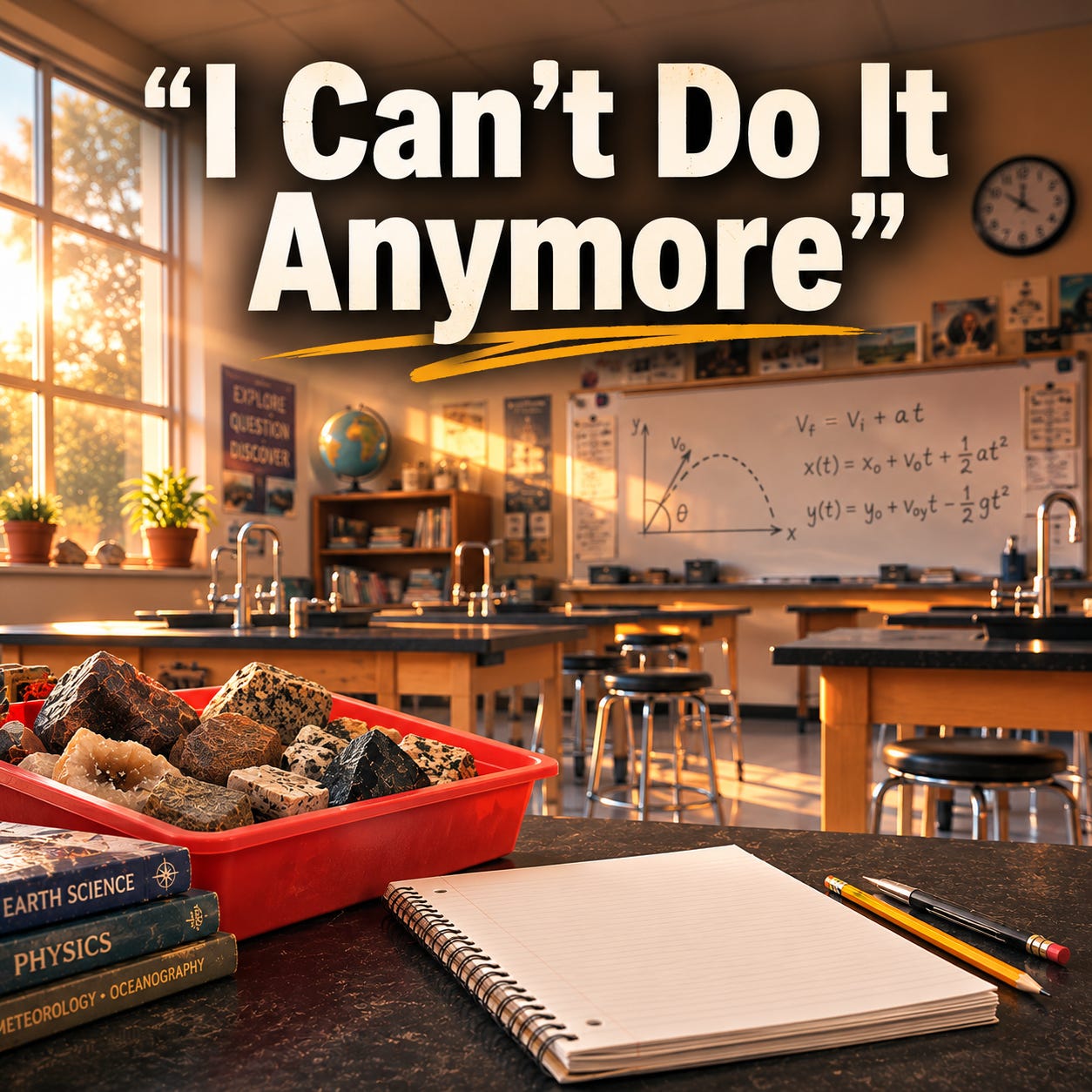
I posted a short video on the morning of my first day of school. This is my forty-first year in education — six of those years I spent consulting with teachers, two more running a school’s tech department, the rest in front of students. Nothing scripted. Just me, an empty room, and a stack of red boxes full of rocks and minerals, an hour before students walked in.
The replies came in fast. Most were kind. A lot of them were from other lifers — thirty-sixth year, thirty-seventh year, one guy starting his thirty-fifth after retiring twice.
But two replies stopped me.
One was from a retired teacher who said she left “crawling to the door.”
The other was fuve words long: I can’t do it anymore.
I’ve been thinking about those two comments for a week. Because the honest question underneath them isn’t “how do you stay excited?” It’s harder than that. It’s: what’s wrong with me that I couldn’t?
Nothing. That’s the answer. But it deserves more than five words back, so here’s the longer version: why I’m still excited to be a teacher, this far in.
First, the part most of these posts leave out
I get to teach in a place that supports me. My administration lets me try things that probably look insane from the outside. I’ve had years where that wasn’t true, and I know the difference, and I’m not going to pretend the difference is attitude.
A teacher grinding through a building with no support, no supplies, a hostile evaluation system, and a hundred and eighty students isn’t failing at joy. She’s responding correctly to her conditions. If you left crawling, you didn’t lack grit. You ran out of a thing that was never being replenished.
So nothing below is a prescription. It’s just what’s kept the fire lit for me, offered in case any of it transfers.
I have never taught the same year twice
There is an old saying for some teachers. They haven’t taught 30 years; they’ve taught the same year 30 times. For me, I am driven by the question: What is best for students? What will help them become thriving human beings? And because the world is always changing, I need to adjust my teaching every year. A few years ago, one colleague told me I made him tired. I kept changing things up, and he wanted everything to stay the same. I understand his sentiment, but maybe I’m just not wired that way. I feel a need to always reflect and ask what worked, what didn’t, and how I can improve.
I remember in the 90s when my student teacher suggested I move to interactive notebooks - and so, boom - that next year I made the big switch. I did that for a few years, and then I was onto something I felt would be better. Or, in 2007, Aaron Sams and I saw that students were missing so much class that we came up with the idea of having them watch videos so they could use class time better. Little did we know that we were birthing the Flipped Classroom movement. Or in the past year, I realized that AI was robbing my students of productive struggle, and I needed to find a way to address this.
This year I’m going backward on purpose. Pencils, paper, real conversation. Content still happens at home, but the room is analog now.
I piloted this method last spring, and this year it’s off to a genuinely strong start — my students are talking to each other, and away from distractions, they’re leaning into the learning. But I already know it isn’t clean. Come Monday’s episode, I’ll get into exactly where it cracked in the first week — the mastery viva didn’t fit into a truncated physics block, and I’m still working out whether it has to happen every single time. That’s not a footnote. That’s the actual answer to how this is going to go: some of it works, some of it breaks, and I find out which is which by running it, not by predicting it.
That’s the whole thing. I have never once known how it was going to go. The teachers I’ve watched burn out weren’t tired of children. They were tired of certainty — of knowing exactly how October would feel, because it had felt that way many Octobers before.
Manufactured novelty is not a gimmick. It’s maintenance.
I stopped being the performer
For my first nineteen years in the classroom, my job was to be interesting for fifty minutes five or six times a day.
That’s a stage career, and stage careers exhaust people. When I moved the content out of the room, the job changed. Now I spend the period walking around, sitting down next to kids, asking them what they think, listening to them be wrong out loud, and watching them fix it.
Performing drains you. Conversation doesn’t. Same hours, entirely different fuel cost.
I remember a teacher visiting my classroom some years ago who asked me how I was still teaching all these years later. She had just spent the day with me and had interacted with my students. After asking, she paused and answered her own question. She said, “Your class is a conversation with students.” I smiled.
I remain a learner — be a novice
For a career teacher, it is easy to know your subject so well that you can do it cold. I remember in about year 15 that I knew the subject so well I would just look at the topic and go. I would stand up (performer mode) and do a lecture without notes. At first I was proud of that, but in retrospect I had stopped being a learner.
My students are novice learners of geology and physics. I need to find areas where I am a novice. A few years ago I decided to learn Spanish. I’m still not fluent, but I keep learning. This morning I completed my 2299th day streak on Duolingo. And this year I am teaching AP Physics C - the C stands for calculus. And my last calculus class was 43 years ago. I am for sure a novice in this arena.
All this to say, we need to allow ourselves to be novices so that we can empathize with our students. So go out and take violin lessons. Or do a dance class, or ask AI to help tutor you in whatever interests you.
Being a beginner at fifty-nine or sixty or sixty-two is uncomfortable, and it is exactly the feeling I’m asking my students to have every single day. I don’t think you can ask a kid to sit in productive struggle if you haven’t been in it recently yourself.
The fire isn’t a personality trait
Here’s what I actually believe after forty-one years around classrooms, in one role or another.
Excitement isn’t something some teachers have, and others lost. It’s a byproduct. It shows up when the work is still uncertain, when you still see individuals instead of sections, and when someone above you gives you enough room to try something that might fail.
Take away any one of those, and it goes out. That’s not weakness. That’s physics.
To the person who said I can’t do it anymore — you gave more than most people ever will to a job that mostly doesn’t say thank you. I hope you find something that gives back.
And to everyone about to walk into a room full of kids who don’t know you yet: I still don’t know how this year is going to go. But I know the question that gets me there. What is best for my students? Go find that answer.
Reach every student.
— Jon
Thanks, Jon, for your openness to what is impacting you. It's inspiring others to take the risks, and enjoy conversing with their students; knowing we don't have to be on stage!! You're still young in my book. I'm learning new things daily, too, and it's a gas! Sometimes a bit frustrating, but keeps me interested in others. Best wishes for a wonderful year!
Nice post, but I think your last statement ask for perfection, and perfection isn't human. I've been in the classroom for 33 years. I've reached many students, but there are also those I likely haven't. With over 100 students each year, asking teachers to reach them all is a recipe for burnout.
My advice to teachers would be to reach at least a few students each year. Some years you'll reach many, other years not as many. That's OK. Do your best, and if you feel like you're improving, and you still enjoy your job, you're ready to come back the next year. 👍